1v1 Video Chat for Cleaner Attention, Better Rhythm, and Easier Conversation Decisions
1v1 video chat works best when you are done browsing broad formats and want a direct conversation that is easier to read, easier to leave, and easier to restart. MatchBlur serves that narrower intent from the first click.
- MatchBlur privacy
- No video recordings stored
- 18+ only

Why 1v1 video chat feels better for users who already know what they want
Many live chat pages still talk as if every visitor wants the same thing. That is weak positioning. Someone searching for 1v1 video chat is already narrowing the field. They are not asking for the broadest live category anymore. They want a format where one person gets their full attention, where social cues are easier to read, and where the conversation does not have to fight through extra noise.
That is why 1v1 deserves its own approach rather than a copy of generic video chat. The point of 1v1 is not just fewer people on screen. The point is a calmer interaction loop: faster entry, clearer pacing, simpler exits, and a better chance that the session feels human instead of scattered.
If that directness still feels too exposed, anonymous chat becomes the better privacy-led route. If the user wants the broader umbrella again, video chat remains the parent category. If they decide they actually want more social context and group energy, chat rooms becomes the better branch.
What makes 1v1 video chat a stronger format for the right session
The strongest explanation is not "it is more personal." It is that the format changes how the conversation behaves from the first minute onward.
Full attention stays in one place
The conversation is not split across room reactions, multiple threads, or performative group energy. Two people can focus on each other without extra social drag.
The rhythm is easier to hold
Back-and-forth feels more natural when the session is not trying to balance several signals at once. That usually means fewer awkward pauses and fewer forced restarts.
Bad fits are cheaper to leave
One weak match does not have to ruin the whole visit. Resetting is part of the experience, which makes the product feel lighter over time.
Useful for practice and confidence
Language learners, shy users, and people rebuilding social ease often do better when the format is direct but not crowded.
Control stays visible
A good 1v1 experience still needs reporting, easy exits, and clean route changes so the user feels in control rather than trapped in politeness.
Browser-first entry keeps momentum
The product should let the user test a real conversation before they spend more time on setup, profiles, or heavy app logic.
Why the format feels lighter
1v1 works because it lowers the number of decisions happening at once. The user is not trying to track room dynamics, side comments, or the feeling that they have to perform for a crowd. They are simply deciding whether one direct conversation has enough energy to continue.
Why that matters in practice
That simpler decision loop changes the whole tone of the product. A good match feels more readable faster. A weak match becomes easier to leave without guilt. The result is not just less noise. It is a more stable session with less wasted attention.
Visual guide
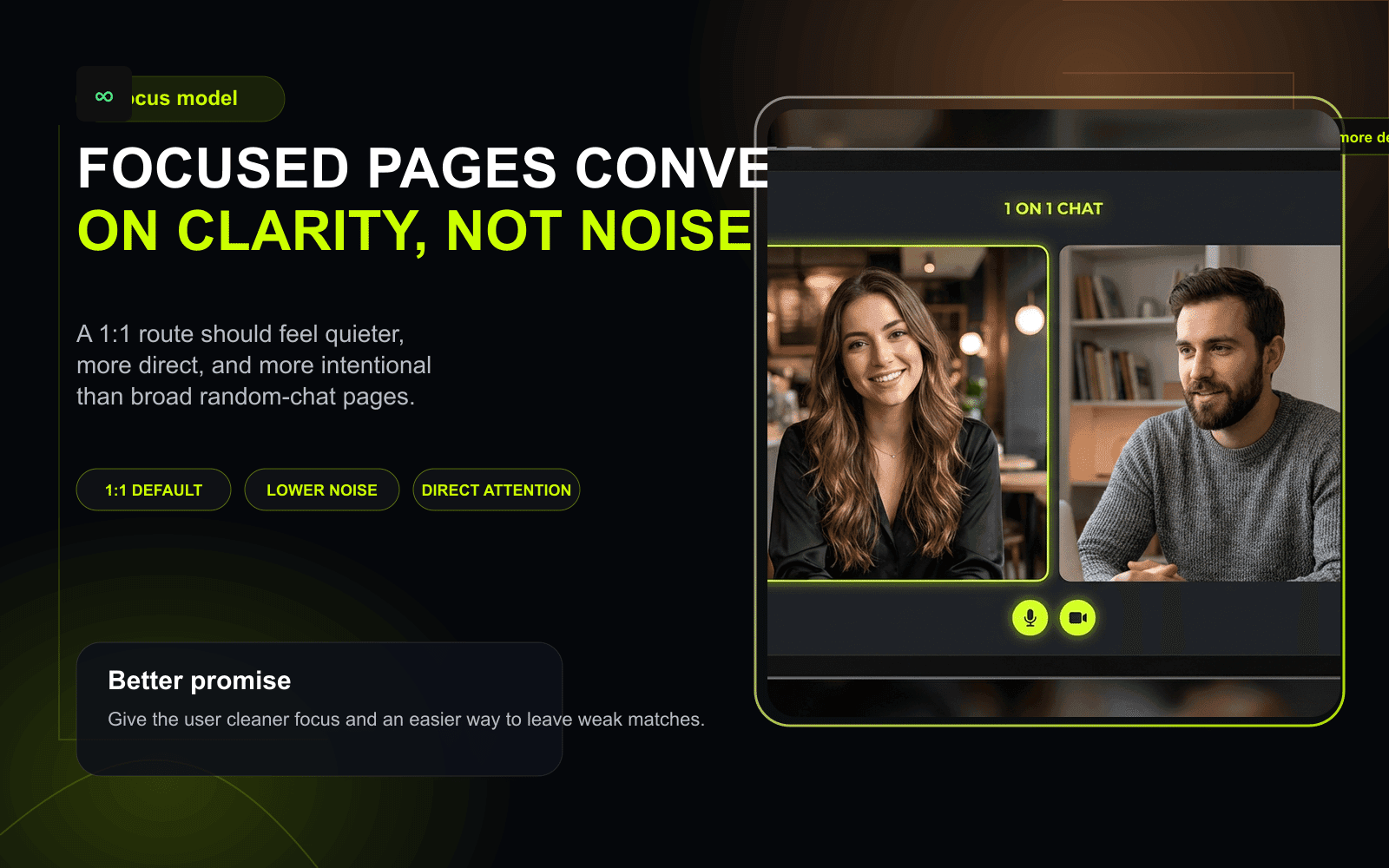
Why 1:1 pages need calmer, more deliberate framing
One-on-one intent is less about volume and more about control. The page should make focus, pacing, and easier exits feel more valuable than randomness.
When 1v1 is the best page to start with
1v1 video chat is for you if your goal is no longer broad discovery. You already know the conversation itself is the real product.
You care more about conversation quality than endless variety
If the goal is a cleaner exchange rather than constant novelty, one-to-one usually fits better than the broader live category.
You want a format that is easier to manage
Direct sessions are simpler to read, simpler to leave, and simpler to restart when the fit is weak.
You want live practice without room pressure
For small talk, language repetition, and lower-pressure social contact, 1v1 often becomes the most useful format on the site.
You want a sharp route when your need changes
The page should still keep anonymous chat, video chat, and chat rooms visible as adjacent options instead of dead ends.
How to get more from 1v1 video chat
The format works best when you use it for what it is designed to do: reduce noise, shorten dead-end sessions, and preserve good conversation momentum.
Enter fast and test the tone early
Do not over-prepare. A strong product should prove its value in the first conversation, not in a long setup ritual.
Reset quickly when the fit is clearly weak
One of the biggest advantages of 1v1 is that low-signal conversations do not need to consume the whole visit.
Switch routes only when the intent changes
Move to anonymous chat if privacy becomes the first filter. Move back to video chat if you want the broader category again.
A practical first-session rule
Give the conversation enough time to show its tone, but not so much time that you stay out of politeness after the fit is already obviously wrong.
A simple decision pattern
- Start with an easy opener so the other person has something natural to answer.
- Watch whether the response feels engaged or mechanically polite.
- Leave without overthinking when the rhythm stays flat after the first exchange.
Why 1v1 behaves differently from broader live formats
The difference is not just smaller scale. The whole conversation unfolds differently when the session is built around one direct interaction at a time.
| Decision point | Broader live or room-style formats | 1v1 video chat |
|---|---|---|
| Attention model | Energy gets split across context, movement, and multiple social signals. | The session is built around one readable interaction from the start. |
| Conversation quality | It is easier for the exchange to become noisy, shallow, or unstable. | It is easier to build a cleaner back-and-forth with fewer distractions. |
| Exit cost | Leaving can feel heavier when the format itself is socially louder. | Resetting feels normal and lightweight inside the one-to-one loop. |
| Best next route | Users often still need to narrow their intent after entering. | Users can stay here unless privacy or wider discovery becomes the stronger need. |
Why a strong 1v1 page cannot sound generic
A generic page talks as if all live chat is interchangeable. A strong 1v1 page does the opposite. It explains that focused attention, easier pacing, and cheap resets are not minor details. They are the actual reason some users prefer this route over every broader format.
That is also why human language matters here. Readers searching this term already have a concrete expectation. If the copy sounds templated, they will assume the product is templated too.
What the promise should really be
The best one-to-one experience does not promise magic chemistry. It promises a cleaner environment for testing chemistry quickly and leaving without friction when it is not there.
The page should keep the cluster visible without diluting the message
1v1 is not an isolated island. You may confirm that direct one-to-one attention is exactly what you wanted. Or you may realize you need the identity distance of anonymous chat or the broader umbrella of video chat.
That internal linking is not filler. It is part of the commercial job. It helps the user move cleanly through the cluster without losing the focus that brought them here in the first place.
1v1 video chat FAQ
Who is 1v1 video chat really for?
It is for users who already know that direct attention and lower noise matter more than the wider variety of a broader live chat format.
Is 1v1 always better than chat rooms?
No. It is better when focus, easier pacing, and cleaner resets matter more than group energy or room context.
When should I switch to anonymous chat?
Use anonymous chat when privacy, slower disclosure, and lower personal exposure become the first decision filter.
Why is 1v1 still linked to broad video chat?
Because video chat is still the broader parent intent in the cluster, and some users need to move back up before they narrow again.
Related commercial routes
These pages stay inside the same live-conversation cluster while letting the user adjust privacy, breadth, or room structure without losing intent.
Use the broader category page if you want the head term before committing to a narrower format.
Use this path if identity distance matters more than one-to-one focus itself.
Use this when you want more room context and social structure than a direct 1v1 flow.
Guides that help after the format decision is clear
These guides should support better conversations and smarter use of the format after the main commercial decision has already been made.
Use this to improve session quality once you already know the one-to-one format fits.
Use this to improve first impressions, pacing, and social outcomes inside live sessions.
Use this when you want stronger boundaries and clearer recovery steps inside live conversations.
Choose 1v1 when the conversation matters more than the category label
If you want cleaner attention, easier pacing, and lighter resets, one-to-one is often the strongest route. Start here, then switch pages only when your real intent changes.
- MatchBlur privacy
- No video recordings stored
- 18+ only