Video Chat Apps Reframed as a Better Browser-First Choice
If you are comparing video chat apps at a category level, here is the case: instant browser access, lower setup friction, and cleaner next-step paths can outperform an install-first stack.
- MatchBlur privacy
- No video recordings stored
- 18+ only

Why “app” pages can still convert in a browser-first product
Video Chat Apps Reframed as a Better Browser-First Choice does not have to mean a native install. For many users the real intent is portable access, device compatibility, and the feeling of a product that is easy to launch from anywhere.
That is why a browser-first app page can still convert well. It reframes the app query around usability, fast access, and lower friction than a traditional install-first route.
If the user really wants the broader live category, keep video chat close. If the reader wants mobile-friendly privacy, keep anonymous chat nearby too.
What makes a browser-first app page strong
The page works when it turns “app” from an install expectation into a usability advantage.
Works across devices
The product feels app-like in access and portability without forcing store-based installation.
Faster launch
Users can start the experience quickly instead of moving through app-store friction first.
Always current
A browser-first product avoids the update lag and fragmentation that installed apps often create.
Cleaner permission framing
The page can explain what is needed for the live session without turning into a heavy install workflow.
Live use stays central
The page still needs to feel like a path into video chat, not like a generic software page.
Low-friction utility
The app query converts best when the product feels easy, light, and available right away.
Visual guide
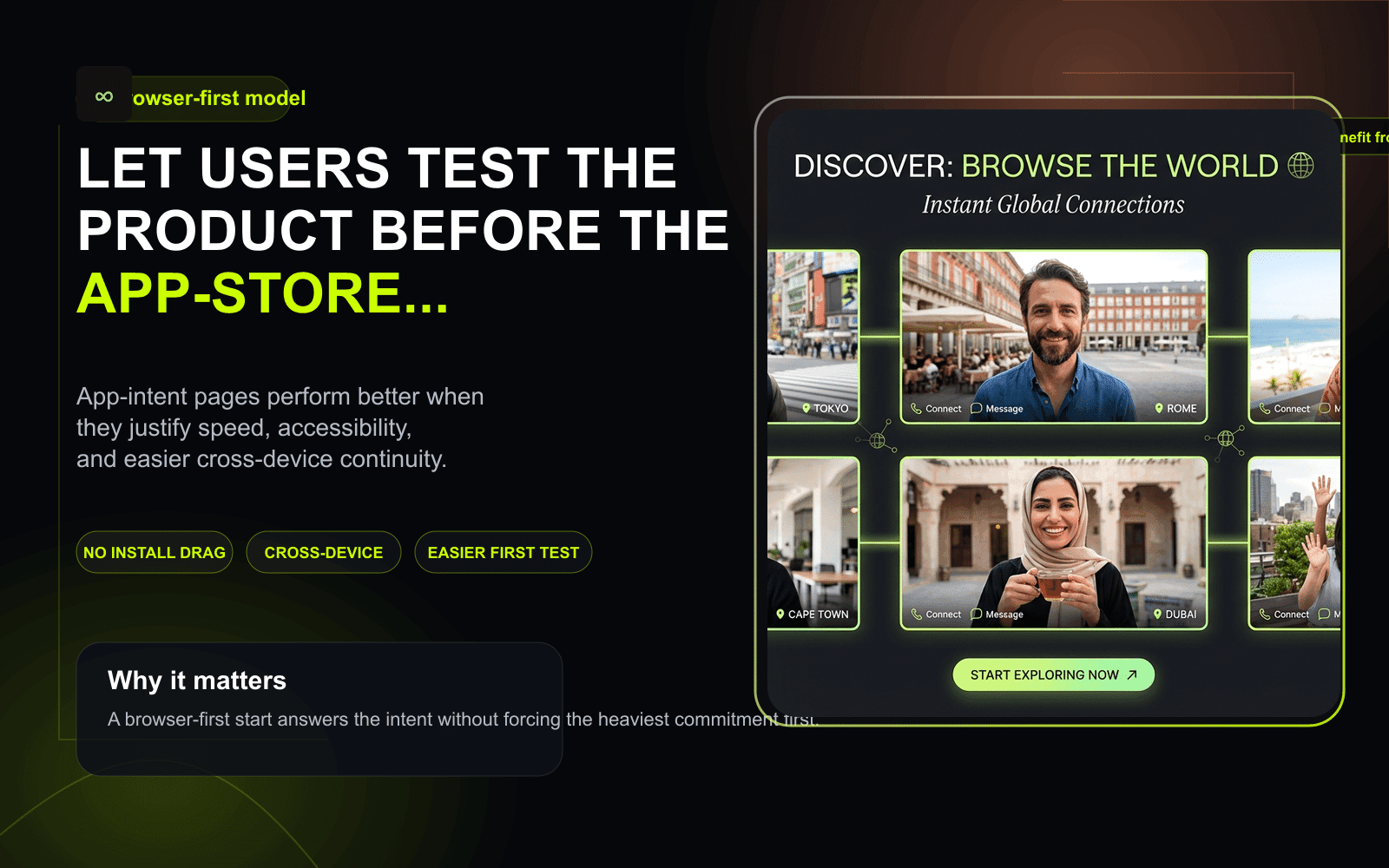
Why app-intent pages still benefit from browser-first framing
Even app-shaped queries usually hide a simpler need: test the experience without committing too early. The page should explain why browser-first access can still be the smarter first move.
Who these pages should convert
The app modifier usually means the reader cares about convenience, portability, and product feel more than about native code specifically.
You want app-like convenience without the install drag
MatchBlur fits when video chat apps reframed as a better browser-first choice is really about quick access and cross-device ease for you.
You want mobile-friendly launch behavior
A stronger browser-first page removes app-store friction while preserving the same live-use value.
You want the cluster nearby after the app question is solved
The page should still route into video chat, 1v1 video chat, or anonymous chat.
You want practical utility, not software jargon
The page should stay anchored to live conversation and access ease rather than drifting into generic application copy.
How to evaluate the app page well
The question is not whether the product calls itself an app. The question is whether it feels easy enough to use like one.
Launch from the browser
A stronger page should prove that the browser-first path is fast enough to satisfy the app intent.
Check portability and friction
Notice whether the experience feels light across phone, laptop, and desktop without extra setup.
Move into the right sibling page if needed
Once the app question is solved, the reader can continue into video chat or anonymous chat.
Why a browser-first app page can outperform an install-first one
The stronger version of the query is about access ease and product readiness, not about installation for its own sake.
| Decision point | Install-first app flow | Browser-first cluster |
|---|---|---|
| First step | The user has to commit to a download before they know if the product fits. | The product can be tested from the browser immediately. |
| Device flexibility | Experience can be fragmented by platform, store, or update state. | The page supports a cleaner cross-device path. |
| Commercial clarity | The query gets trapped in software language. | The page keeps the app intent tied to live conversation value. |
| Cluster depth | The path stops at the install question. | The user can continue into video chat and 1v1 video chat. |
Why app intent is still worth capturing this way
Because users often search for video chat apps reframed as a better browser-first choice when what they really want is easy access and a product that feels ready to use now.
That means a browser-first page can still be the best answer if it explains the benefit clearly and makes the product feel immediate.
The page should connect ease-of-access to the live cluster
That is what keeps the page commercially useful. Once the user accepts the browser-first value, they should see the next best pages in the cluster without confusion.
Guides like video chat app comparison and video chat safety guide reinforce the choice lower in the page.
Video chat app FAQ
Why can video chat apps reframed as a better browser-first choice work as a browser-first page?
Because many users mean fast access and cross-device usability when they say app. A browser-first product can satisfy that intent more efficiently than an install-first flow.
What if I just want the broad live category?
Use video chat. That page is the stronger commercial parent when the app-specific framing is no longer the main issue.
What if privacy matters more than access style?
Use anonymous chat. That page is the better route when lower identity exposure is the first requirement.
Should this kind of page still support editorial links?
Yes. It should just answer the access question first and use editorial guides as reinforcement lower in the flow.
Commercial sibling pages
These are the next pages inside the same commercial journey once the reader’s intent becomes more specific.
Use this if the user really wants the head live category once the app question is solved.
Use this if the comparison is actually driven by cost sensitivity more than by access style.
Supporting guides
These editorial pieces support the decision once the landing page has already answered the commercial question clearly.
Use this if the reader wants the editorial comparison layer after the landing page answers the commercial question.
Use this if trust and privacy become the next concern after access style.
Use app intent to prove ease-of-access, then move deeper into the cluster
A strong browser-first app page should remove install friction, keep live value visible, and then route the user into the right sibling page if the use case changes.
- MatchBlur privacy
- No video recordings stored
- 18+ only