Talk to Strangers Online Without Turning the Page Into Generic Advice
If you searched talk to strangers, you probably want a live way to meet someone new now, not another article about confidence. MatchBlur gives you a direct route into social discovery, with clear paths into video chat, 1v1 focus, and privacy-led conversation when you need them.
- MatchBlur privacy
- No video recordings stored
- 18+ only

Why this query deserves a real commercial page
People search "talk to strangers" for more than novelty. Sometimes they want a break from feed-driven social apps. Sometimes they want conversation without a profile graph. Sometimes they simply want a live product that makes new contact feel lighter, faster, and less socially loaded than mainstream platforms.
That is why you will not find lifestyle coaching here. You get a strong front door into live social discovery, with clean routes into video chat, 1v1 video chat, and anonymous chat when you realize one of those narrower formats fits better.
The broader social intent also makes talk to strangers a bridge. It sits between the main live formats and the supporting guides that help you use the format more effectively once you arrive.
What you actually get
The strongest version of the keyword is not abstract. It is about using the product to create real-time social discovery with less friction than mainstream social apps or passive messaging platforms.
Fresh people, not a static graph
The appeal is meeting someone outside your usual circle without wading through a long profile stack.
Faster start
The page should help the user begin a real conversation quickly instead of spending energy on preparation before the first signal appears.
Lower-pressure conversation
The product gives people a cleaner way to talk without treating every interaction like a long-term social commitment.
Useful for practice and confidence
Many users land here for language repetition, social confidence work, or a wider sense of cultural contact.
Guardrails still matter
The social energy of the query only converts when the user can still see control, exits, and reporting clearly.
Live interaction stays central
The page should preserve the real-time value of the product instead of dissolving into generic chat copy.
Why the query feels natural
This query works because it sits closer to how people actually think. Many users do not start with a platform label or a product term. They start with the social outcome they want: to talk to someone new without a heavy app or a complicated social graph in the way.
Why grounded copy converts better
That makes the page commercially strong when it stays grounded. The copy should help the user act on the desire for live contact, then route them toward more specific formats only when the need becomes clearer.
Visual guide
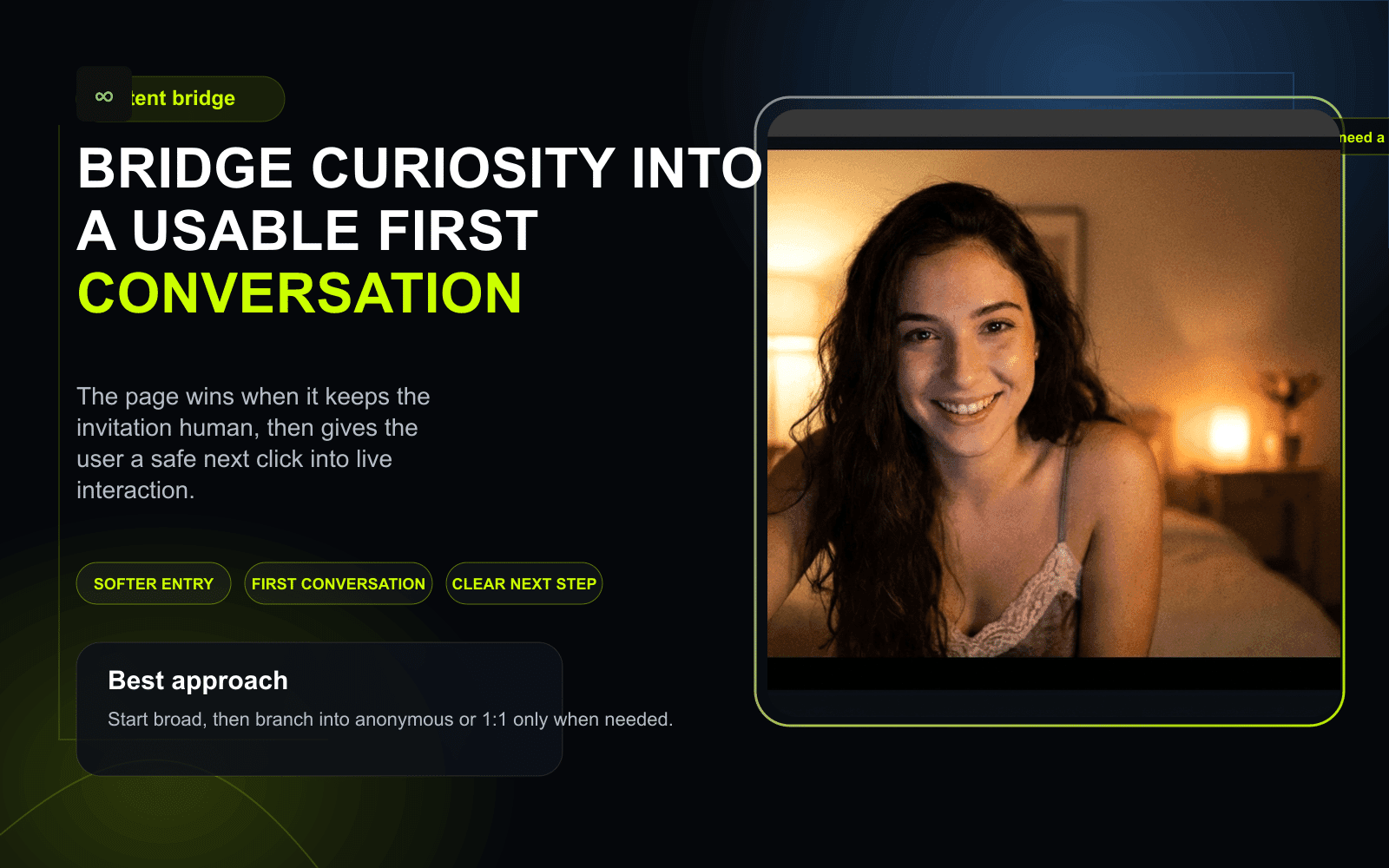
Why talk-to-strangers pages need a softer entry frame
This query is often broader and more emotional than pure product language. A stronger page turns that emotional search into a practical next step without feeling pushy.
Who gets the most out of talk to strangers
The query is broad, but the action patterns behind it are surprisingly consistent once you look at what the user is really trying to do.
You want to meet people outside your usual bubble
Talk to strangers fits when you want new contact more than another feed, inbox, or profile-driven app.
You want to practice conversation in real time
The product works well for social confidence, language repetition, and low-stakes live interaction.
You want a broad front door into more specific formats
From here the user can move naturally into 1v1 video chat, chat rooms, or anonymous chat.
You want the social-discovery angle of the category
This is the better page when the head keyword feels too product-centric and the brand-comparison pages feel too narrow.
How to get better stranger conversations
You should not just be sent into a product. You should also get help using the format more effectively once you arrive.
Start light and let the conversation build
Begin with easy topics and let the product do the discovery instead of forcing intensity too quickly.
Move on when the fit is obviously weak
The format works because no single conversation has to carry the whole visit, especially in the first few minutes.
Narrow the route when the pattern becomes clear
If you want more focus, go to 1v1 video chat. If you want more privacy, go to anonymous chat.
Three practical habits
- Use short, easy openers that invite a real answer instead of a forced performance.
- Notice whether the other person is helping to carry the conversation or leaving all the work to you.
- Treat switching formats as normal. Broad social discovery is a starting point, not a trap.
Why this beats passive social scrolling for the query
The strongest alternative to passive social behavior is not always another profile app. Often it is a product that lets the next conversation happen now.
| Decision point | Passive social scrolling | Talk to Strangers live flow |
|---|---|---|
| Discovery | You browse people indirectly through content, photos, and profile signals. | You meet someone directly inside a live session. |
| Speed to interaction | The product is optimized for looking, not talking. | The product is optimized for getting into the conversation fast. |
| Conversation pressure | Every move can feel more socially loaded because it sits inside your broader identity graph. | The interaction can stay lighter and lower-pressure. |
| Best next step | You often stay inside the same passive loop. | You can narrow into video chat, 1v1 video chat, or anonymous chat as your intent sharpens. |
Why the page should stay practical
The query has obvious social and lifestyle angles, but that does not mean the page should become soft or vague. A strong commercial page still needs to explain the format, reduce friction, and push the user toward the right next click.
That is what separates useful commercial content from generic "meeting people online" copy that ranks weakly and converts even worse.
Why the tone matters
Human language matters here because the search itself is human. People do not type this query because they want jargon. They type it because they want contact.
Talk to strangers works like a junction
Some readers should stay on the broad social-discovery path. Others should step into video chat. Others should immediately prefer anonymous chat or 1v1 video chat. The page wins when it helps those choices happen without confusion.
That also makes the supporting blog more useful because the guides can stay focused on technique, etiquette, and safety instead of carrying the whole commercial job themselves.
Talk to strangers FAQ
Who should land here instead of on the video chat page?
Users whose search intent is broader and more social, but who still want a real-time product path rather than passive content or messaging.
Can I move into more specific formats from here?
Yes. That is part of what makes it commercially strong. It should move readers into video chat, 1v1 video chat, chat rooms, or anonymous chat when the use case sharpens.
Does starting a chat here replace safety guidance?
No. It should convert the social-discovery intent first, then support the reader with safety and etiquette guides lower on the page.
What makes this stronger than generic social advice content?
It is tied directly to a live product path and to the wider commercial cluster, not just to abstract advice about talking to people.
Commercial paths from the social-discovery query
These pages keep the user inside the same journey while narrowing the format to something more specific when the need becomes clearer.
Use this if you want the broad live category rather than the social-discovery framing.
Use this if you want quieter, more direct conversations after the first discovery layer.
Use this if privacy becomes the first factor before the next live session.
Use this if you want the camera-first way to meet someone new, with MatchBlur on from the start.
Supporting guides after the main click is clear
These articles make the page stronger by helping users have better conversations after they enter the format.
Use this for practical ideas on how to make live stranger conversations flow better.
Use this to improve social rhythm, reduce awkwardness, and protect conversation quality.
Use this if you want the tactical safety layer behind the social-discovery query.
Use the social query as a live doorway, not just a topic
A strong talk-to-strangers page should get the user into conversation quickly and then route them to the right sibling only when the need becomes more specific.
- MatchBlur privacy
- No video recordings stored
- 18+ only